Founder Scaling Dynamics
Why growing companies require different organizations, management systems and founder leadership at each stage.
A research-grounded map of the five games founders must master to move from viability to institutional scale.
Brett Thomas · Founder Leadership
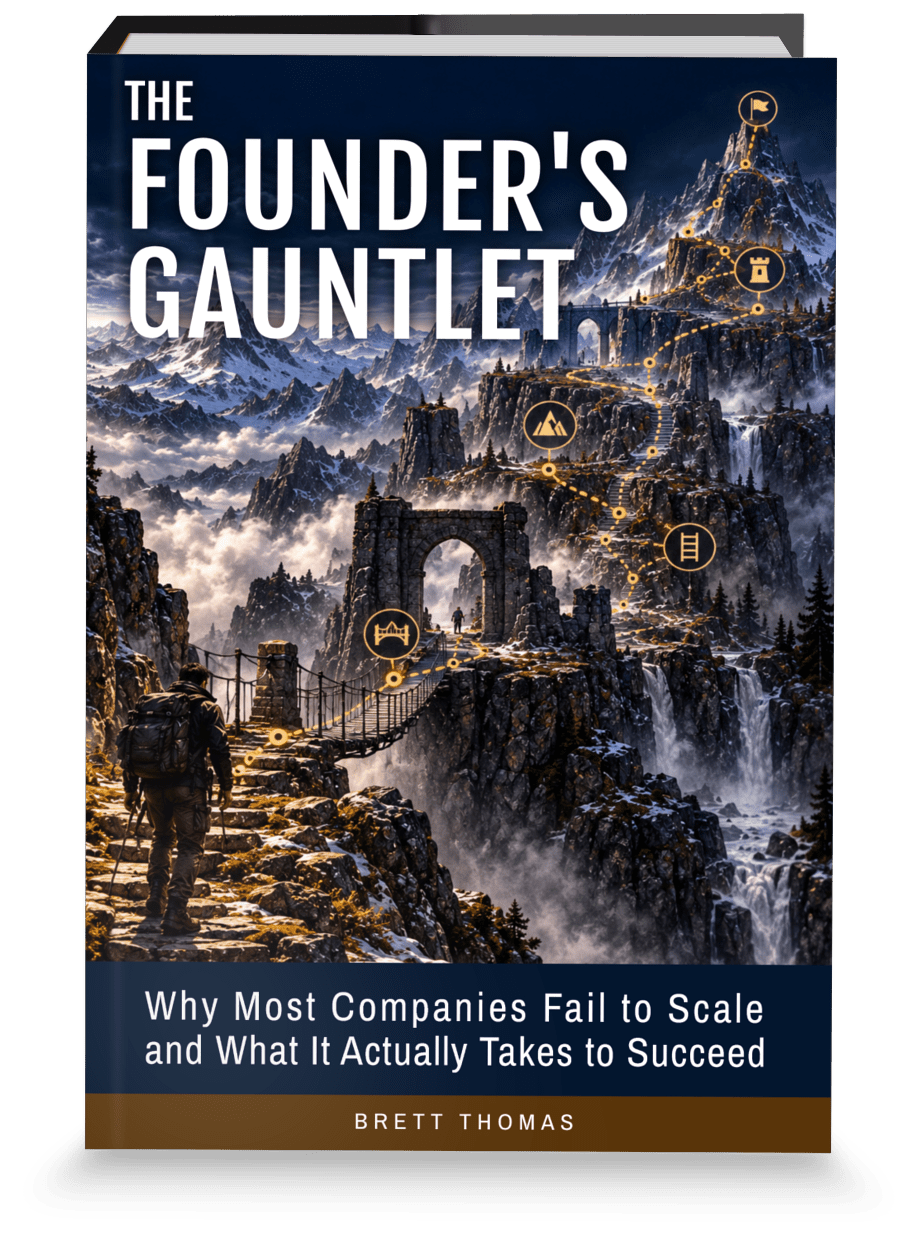
Adapted from the book
White paper adapted from The Founder's Gauntlet by Brett Thomas
Explore the book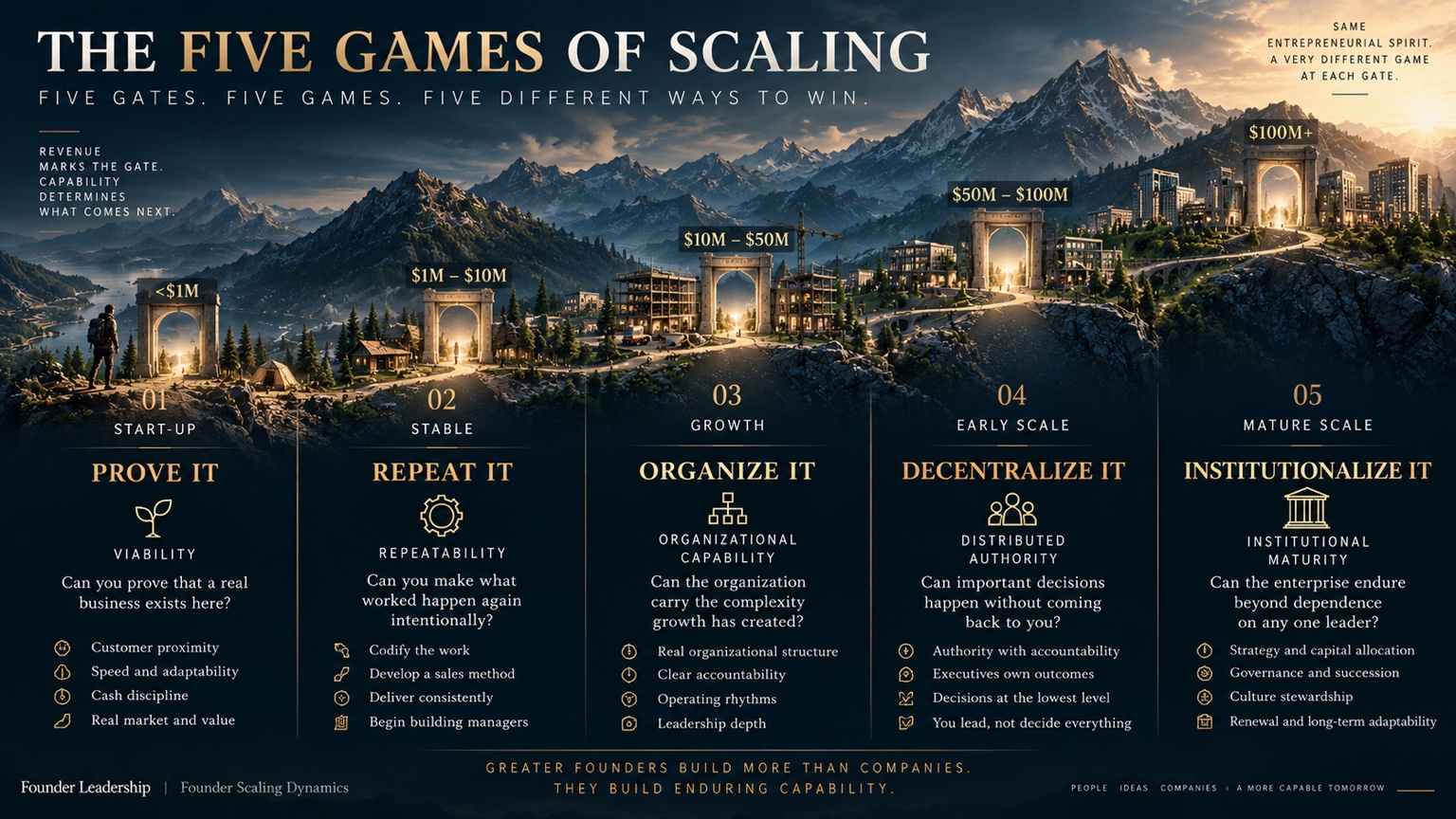
Every period of growth changes the company that produced it.
More customers create more exceptions. More employees create more handoffs. More specialized functions create more dependencies. More managers create more decisions about who decides, who coordinates and who remains accountable.
More than six decades of organizational-growth research point toward a common conclusion: the management model that works at one level of complexity becomes insufficient at the next.
Founder Scaling Dynamics turns that research into a founder-facing map. It describes five stages of development, each with a different game, objective and winning condition.
The central argument is practical. Founders get into trouble when they solve the wrong game. They import later-stage practices before the prerequisite capability exists, or keep using earlier-stage practices long after complexity has changed the problem.
01
Growth changes the company before most founders change the leadership model
In the earliest years, founder centrality is often efficient. The founder knows the customer, understands the product, sees the work and can make decisions quickly. Few people need to coordinate, information paths are short and judgment is concentrated in the person with the most context.
Growth alters that equation. Each new customer, employee, manager, location, service line and product adds relationships that must be coordinated. The company does not simply become a larger version of the same organization. Its management problem changes.
The founder can still solve the client issue faster, close the important deal and see what the manager missed. The company therefore continues using founder capability whenever its own capability is insufficient. Over time, this teaches the organization to route complexity upward.
The problem is developmental. The company has moved into a new game while the leadership model is still optimized for the previous one.
02
What sixty years of stage and lifecycle thinking agree on
The organizational-growth literature contains many competing stage models. Greiner described recurring phases and management crises. Churchill and Lewis described Existence, Survival, Success, Take-Off and Resource Maturity. Adizes examined the transfer from entrepreneurial control toward professional management. Flamholtz and Randle described New Venture, Expansion, Professionalization, Consolidation, Diversification and Institutionalization.
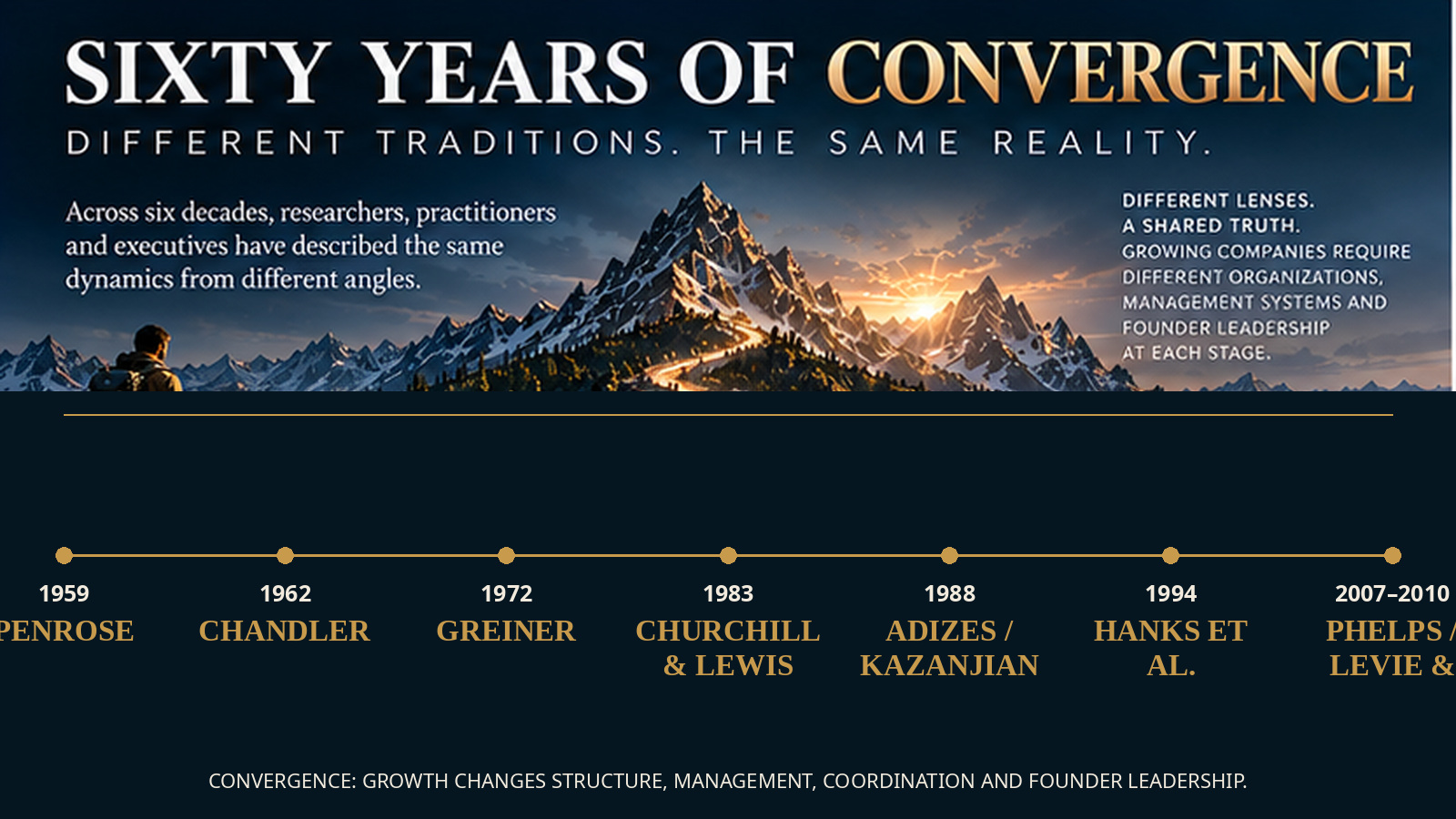
Beneath the different terminology, five themes repeat. Problems change as the organization grows. Earlier management practices become inadequate. Previously unnecessary capabilities become required. Structure and decision processes become more explicit. The leader's role changes as complexity increases.
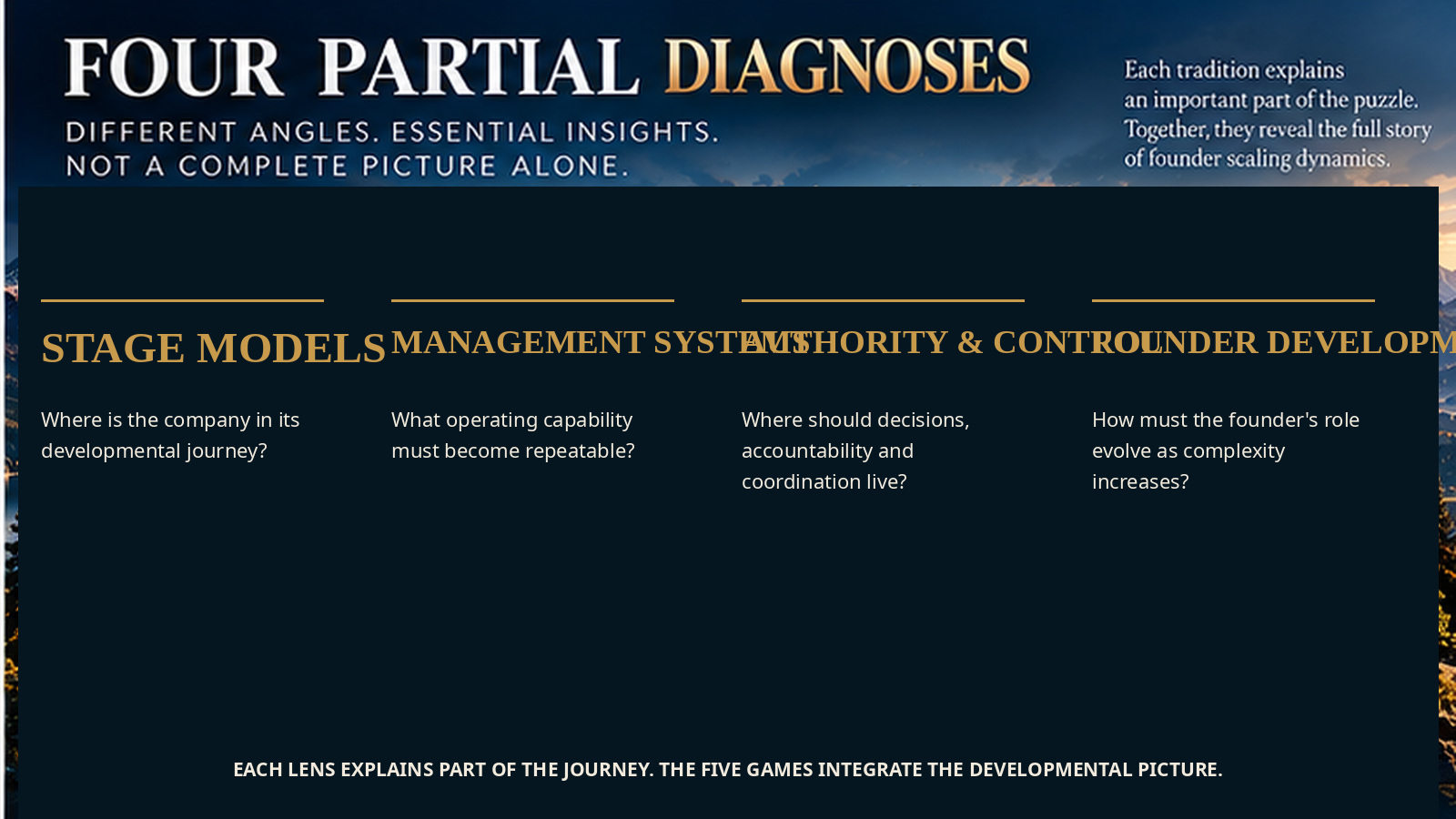
The research also warns against treating stages as a mechanical sequence. Founder Scaling Dynamics accepts that caution. Stages are regions of developmental terrain. Revenue and headcount help locate the company, but capability determines the diagnosis.
03
Why use revenue and employee ranges?
Most lifecycle theorists did not publish fixed dollar thresholds. Flamholtz and Randle did use revenue as a surrogate for organizational size, with boundaries near $1 million, $10 million and $100 million. Founder Scaling Dynamics adds a $50 million gate because a $15 million company building a management system faces a different problem from an $80 million company with capability but overly centralized authority.
Revenue captures economic scale. Headcount captures part of the coordination problem. Used together, they create a better first approximation than either measure alone. Their disagreement is informative. A $20 million software company with 25 employees and a $20 million services business with 120 employees may be playing different versions of the same game.
The Five Games
Every gate opens a new game. Every game has a different objective. Master what the current game requires, then earn the right to play the next one.
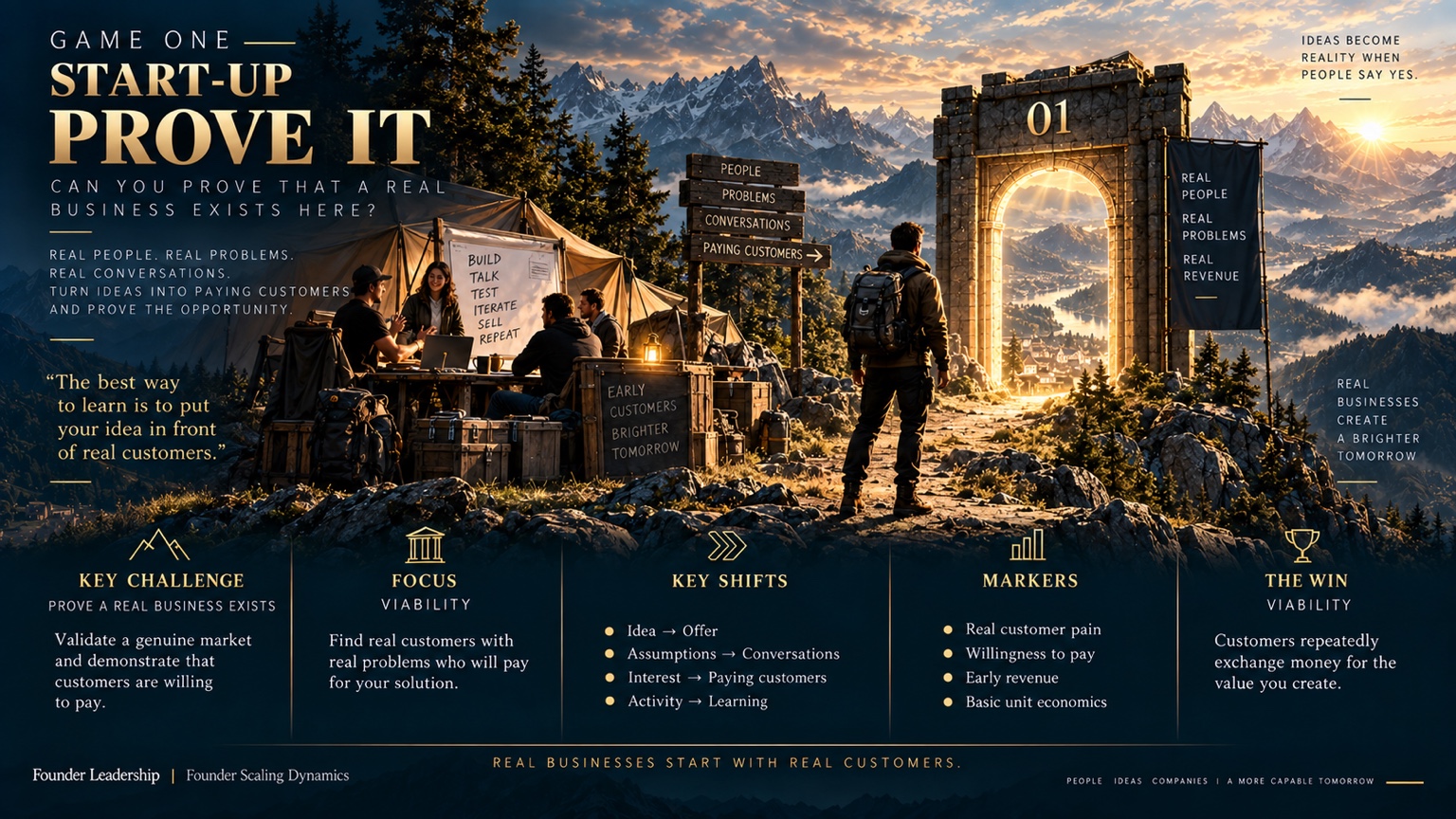
01
Start-Up
Below roughly $1M
1–10 employeesThe game
Prove It
Mastery: Viability
Winning condition
A market and viable economic engine exist.
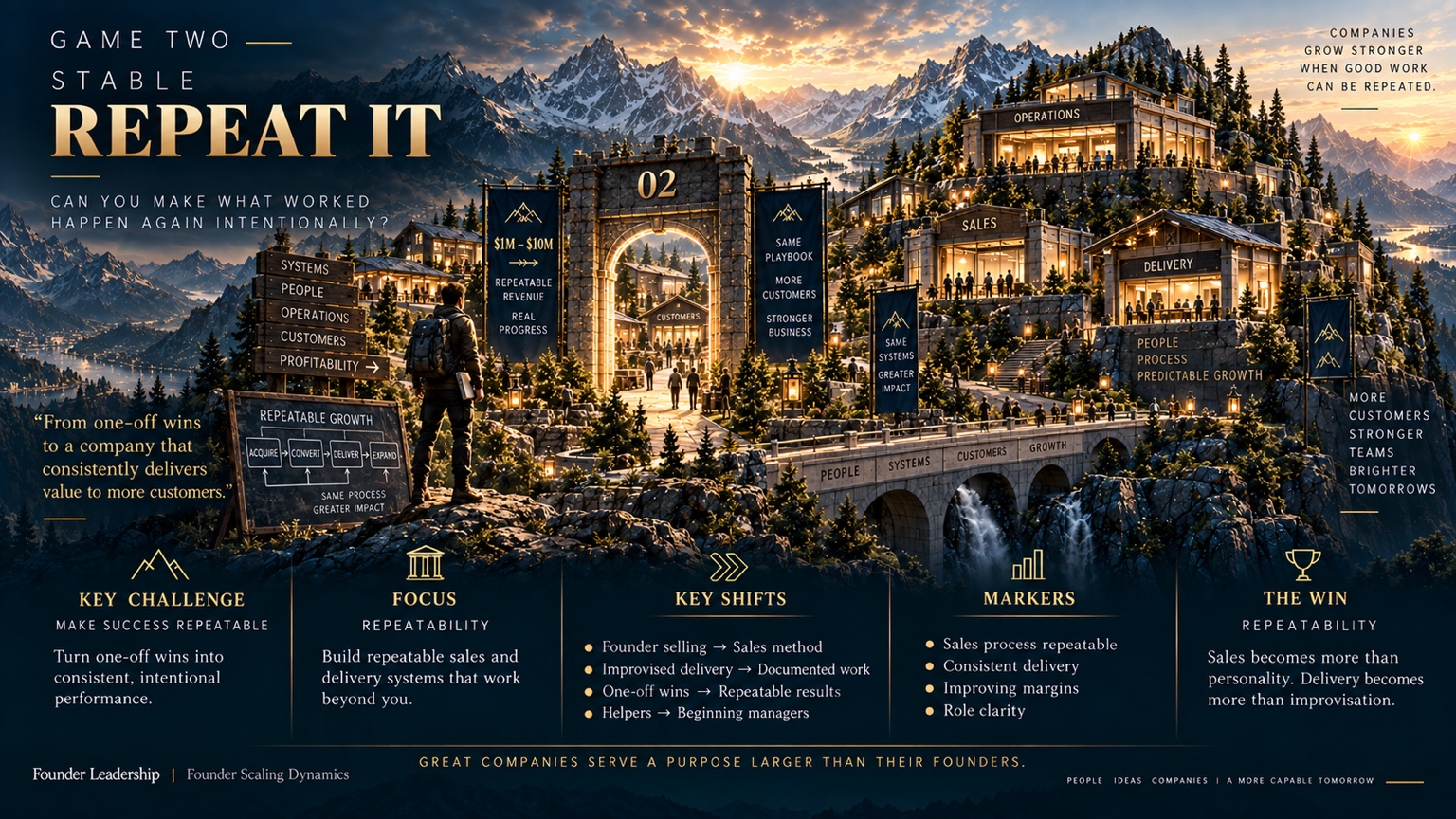
02
Stable
Roughly $1M–$10M
10–20 employeesThe game
Repeat It
Mastery: Repeatability
Winning condition
Sales, delivery and core operations can be reproduced with increasing reliability.
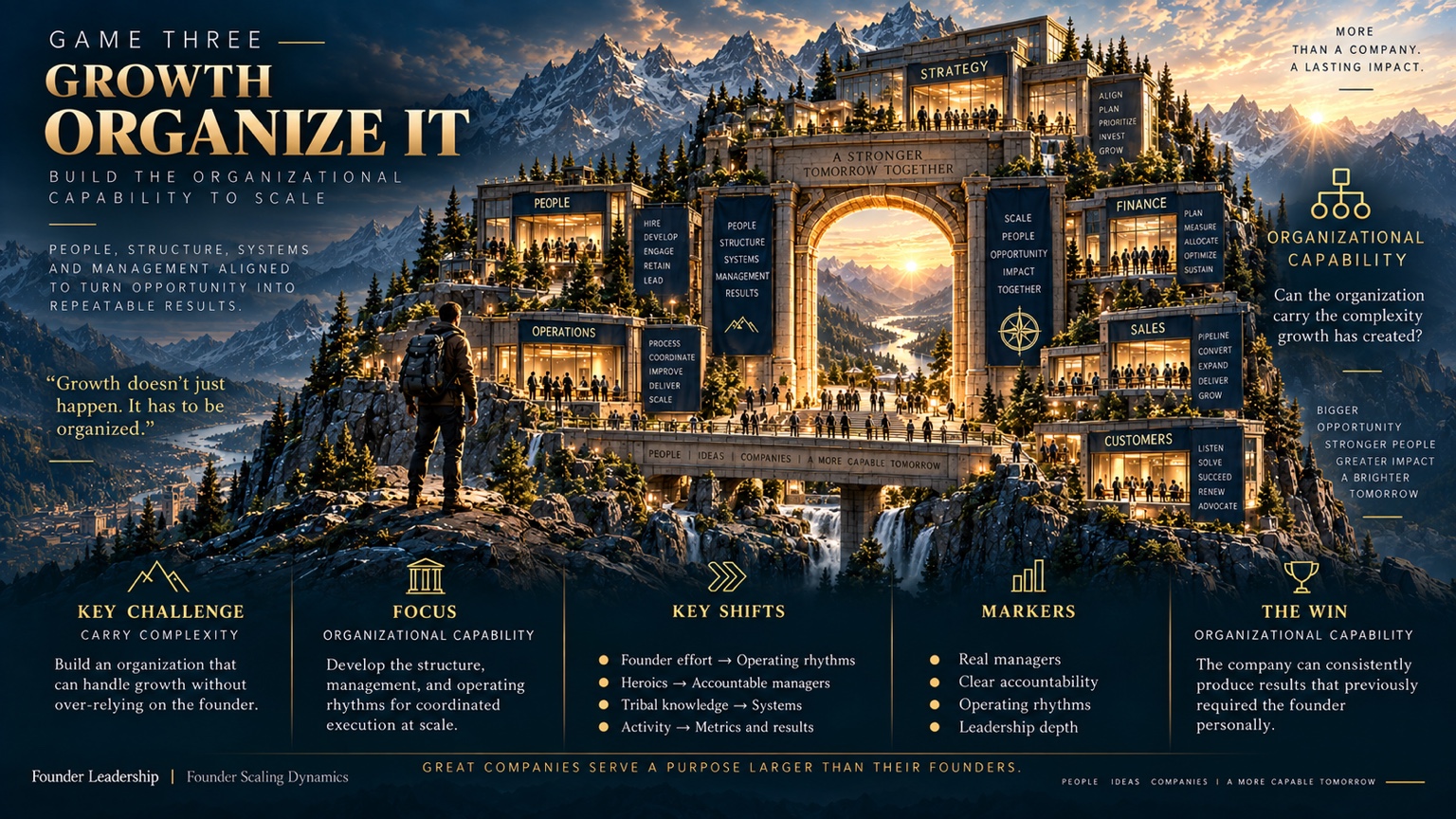
03
Growth
Roughly $10M–$50M
20–100 employeesThe game
Organize It
Mastery: Organizational Capability
Winning condition
The organization can consistently produce results that once required founder intervention.
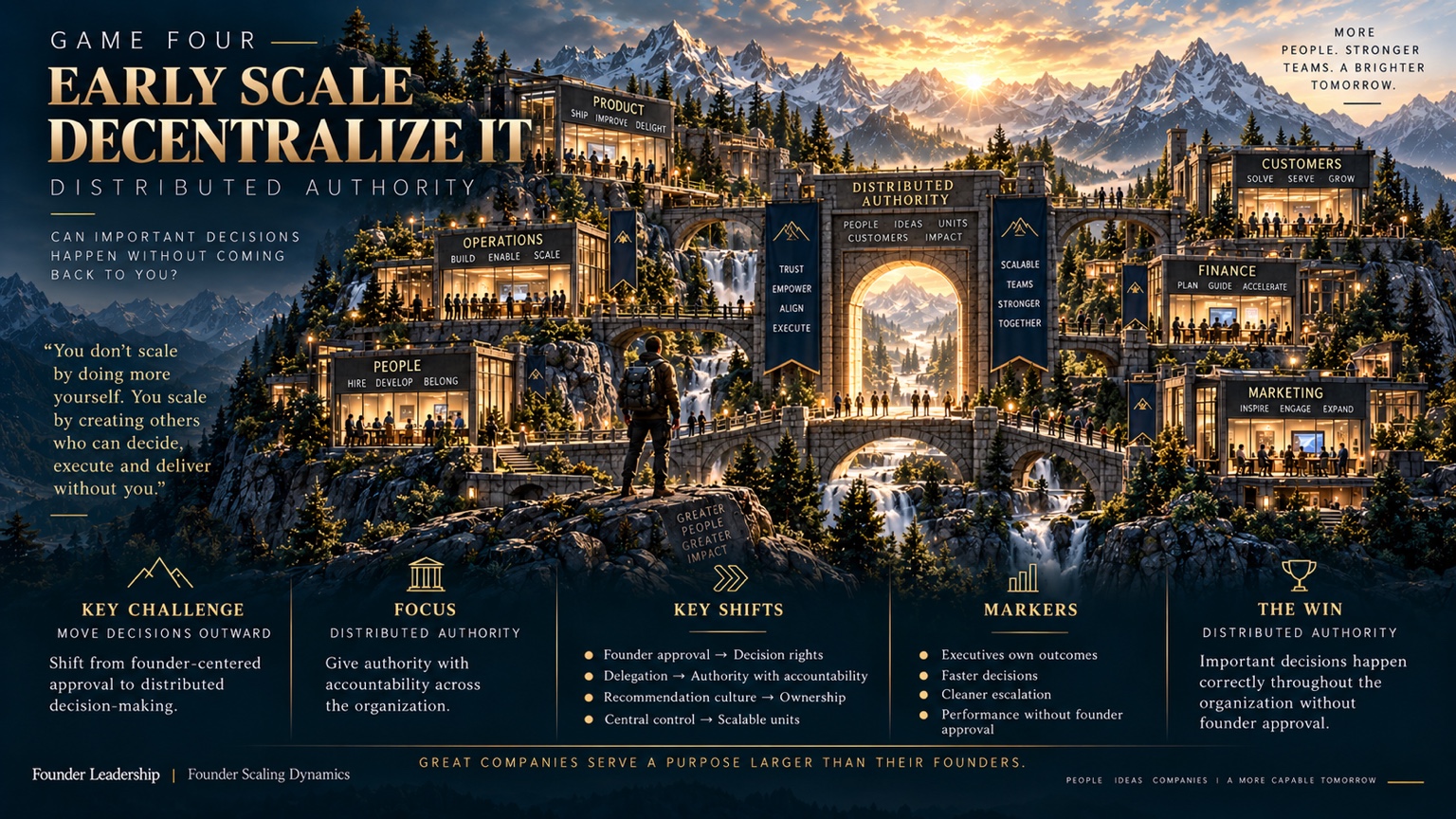
04
Early Scale
Roughly $50M–$100M
100–200 employeesThe game
Decentralize It
Mastery: Distributed Authority
Winning condition
Capable leaders make consequential decisions within clear boundaries.
05
Mature Scale
Roughly $100M+
Hundreds to thousandsThe game
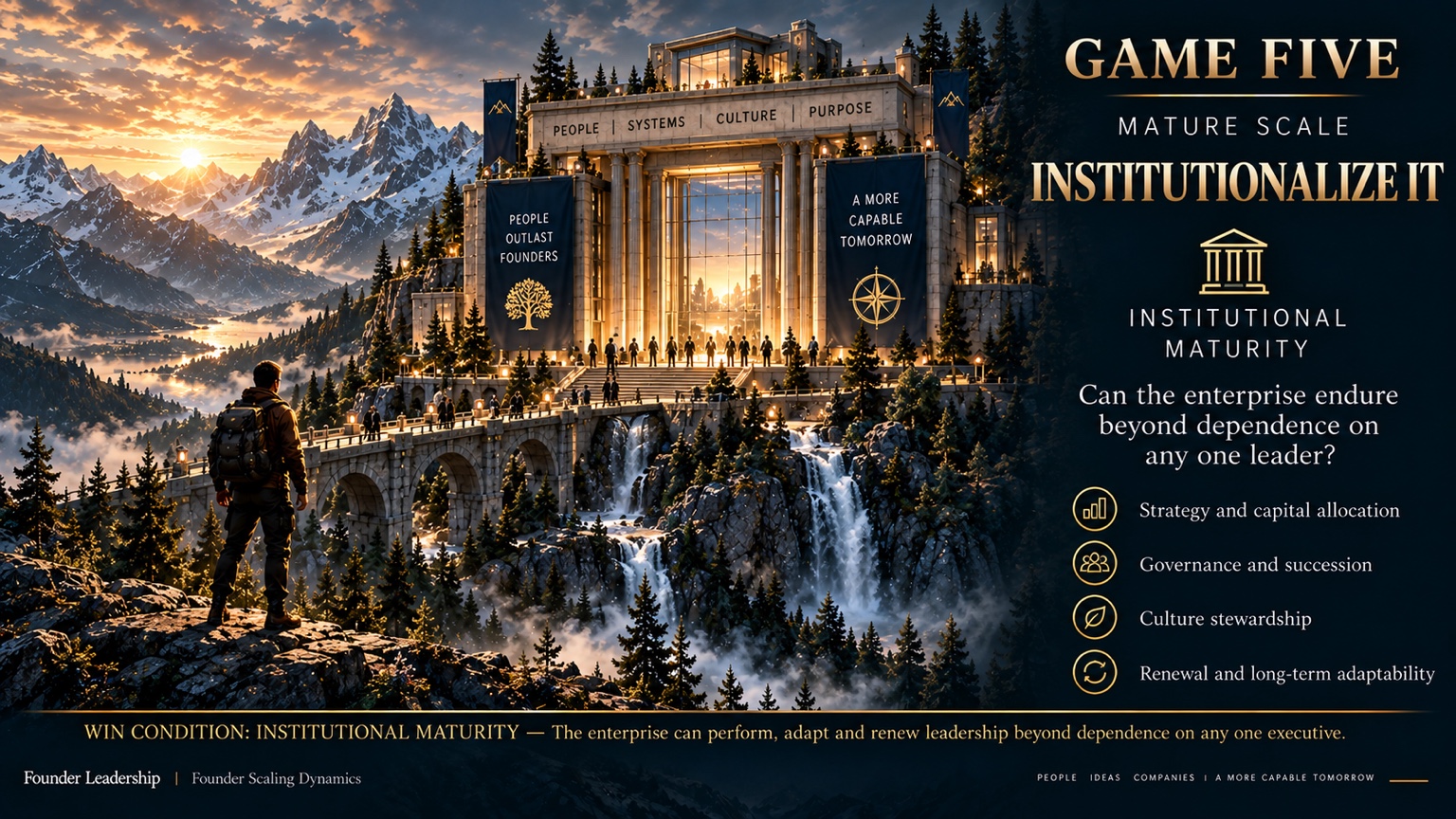
Institutionalize It
Mastery: Institutional Maturity
Winning condition
The enterprise can perform, adapt and renew beyond dependence on one leader.
05
The Growth-to-Early-Scale crossing is the center of gravity
For most growth-stage founders, the most consequential passage occurs between roughly $10 million and $50 million. The founder's old operating model can still produce good short-term results while becoming increasingly expensive as an organizational design.
The work of Growth is converting founder-enabled performance into organizational capability. Founder-generated opportunity becomes a broader revenue engine. Tribal knowledge becomes explicit operating capability. Individual managers become a management system. Informal communication becomes intentional cross-functional coordination. Habitual escalation becomes bounded decision making.
The sequence matters. Distributed authority works best after sufficient capability exists to receive it. Growth asks, “Can the organization itself produce the result?” Early Scale asks, “Can capable leaders exercise meaningful authority without routing routine complexity back to the center?”
06
Revenue, Operations and Leadership do not mature at the same speed
A single stage label can hide important differences. A $20 million company can have a $20 million revenue engine, a $10 million operating model and a $5 million leadership system. The next move should strengthen the capability constraining the current game.
Revenue
Can the company create, retain and expand economically sound demand with increasing predictability, without depending on the founder as the commercial engine?
Operations
Can the company deliver reliably through explicit methods, role clarity, quality standards and planned capacity rather than tribal knowledge?
Leadership
Can managers and executives set priorities, make decisions, coordinate across functions and own outcomes without excessive founder intervention?
07
Good advice can be bad advice in the wrong game
Most business advice contains an implied company. It assumes a certain level of cash, management depth, process maturity, market certainty and leadership capability. Remove those assumptions and excellent advice can create damage.
“Delegate more” is useful when capable people, clear outcomes and enough decision context already exist. “Push decisions down” creates leverage when managers can exercise judgment inside clear boundaries. “Document the process” helps when the work has repeated enough to deserve a standard.
What game was this built for, and what capability does it assume already exists?
08
Stabilize before you scale
Growth amplifies the operating pattern already present. When capability is reliable, additional volume creates leverage. When capability is fragile, additional volume increases rework, escalation, inconsistency and cash pressure.
Stabilization does not mean refusing growth. It means strengthening the capability that the next level of demand will expose. In Revenue, that may mean improving repeatability, margin quality or customer concentration. In Operations, it may mean clarifying core methods, ownership and capacity constraints. In Leadership, it may mean defining management outcomes, decision rights and cross-functional coordination.
What must become reliably true before we ask this company to absorb another level of complexity?
09
The founder's work changes with the game
In Start-Up, the founder is creator, seller, learner and problem solver. In Stable, the founder begins turning successful improvisation into methods other people can learn. In Growth, the founder increasingly builds managers, systems and organizational capability.
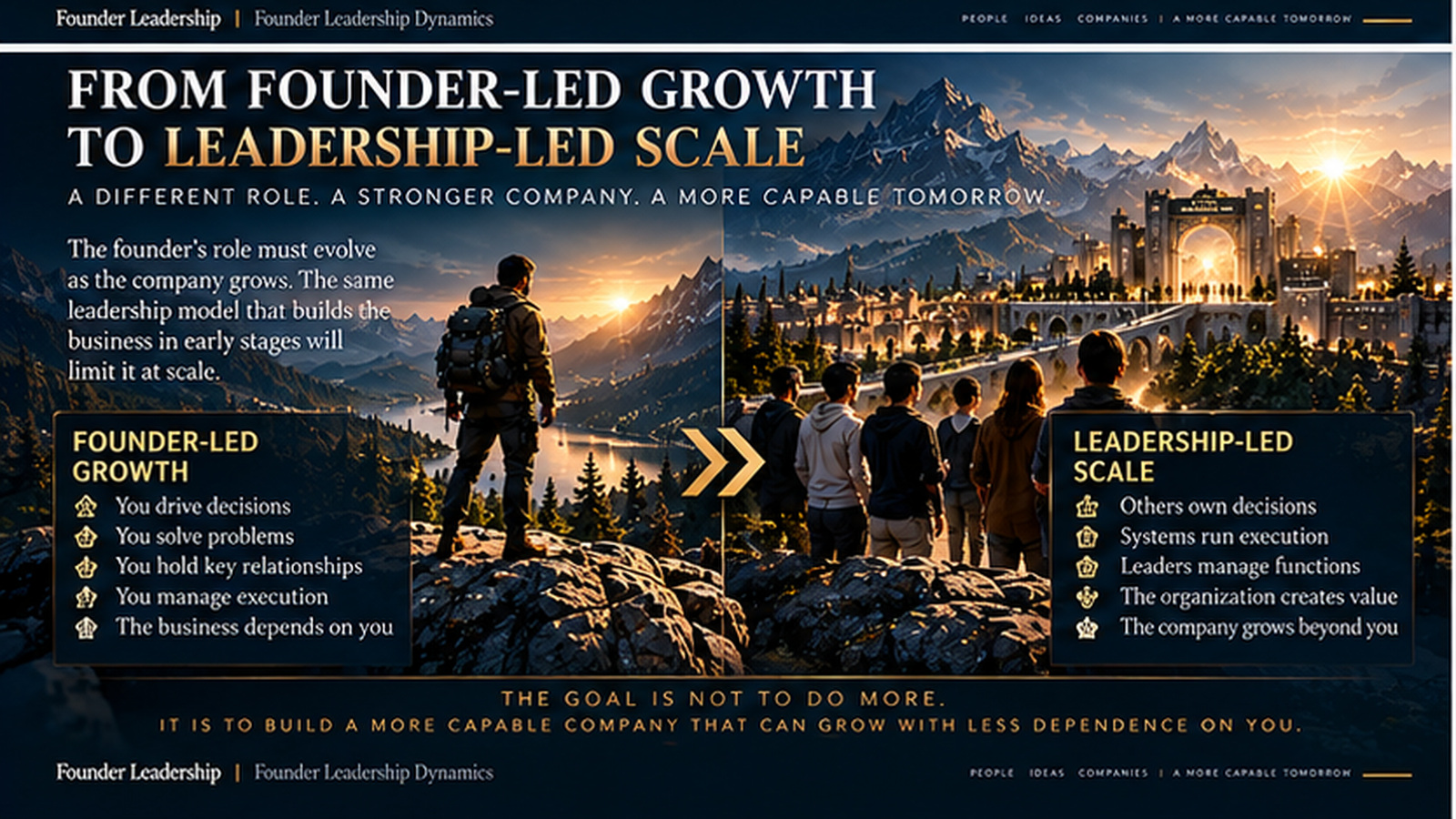
In Early Scale, the founder must allow capable leaders to exercise authority. In Mature Scale, the work moves toward strategy, capital allocation, executive leadership, governance and institutional renewal.
The destination is not founder absence. It is a company whose performance no longer requires constant founder intervention and a founder whose contribution rises with the complexity of the enterprise.
Know the game you are in.
Founder Scaling Dynamics is a map for recognizing what the company is being asked to become next. Its purpose is practical: to explain why previously successful methods begin producing friction and why a company can have more talent while depending more heavily on the founder.
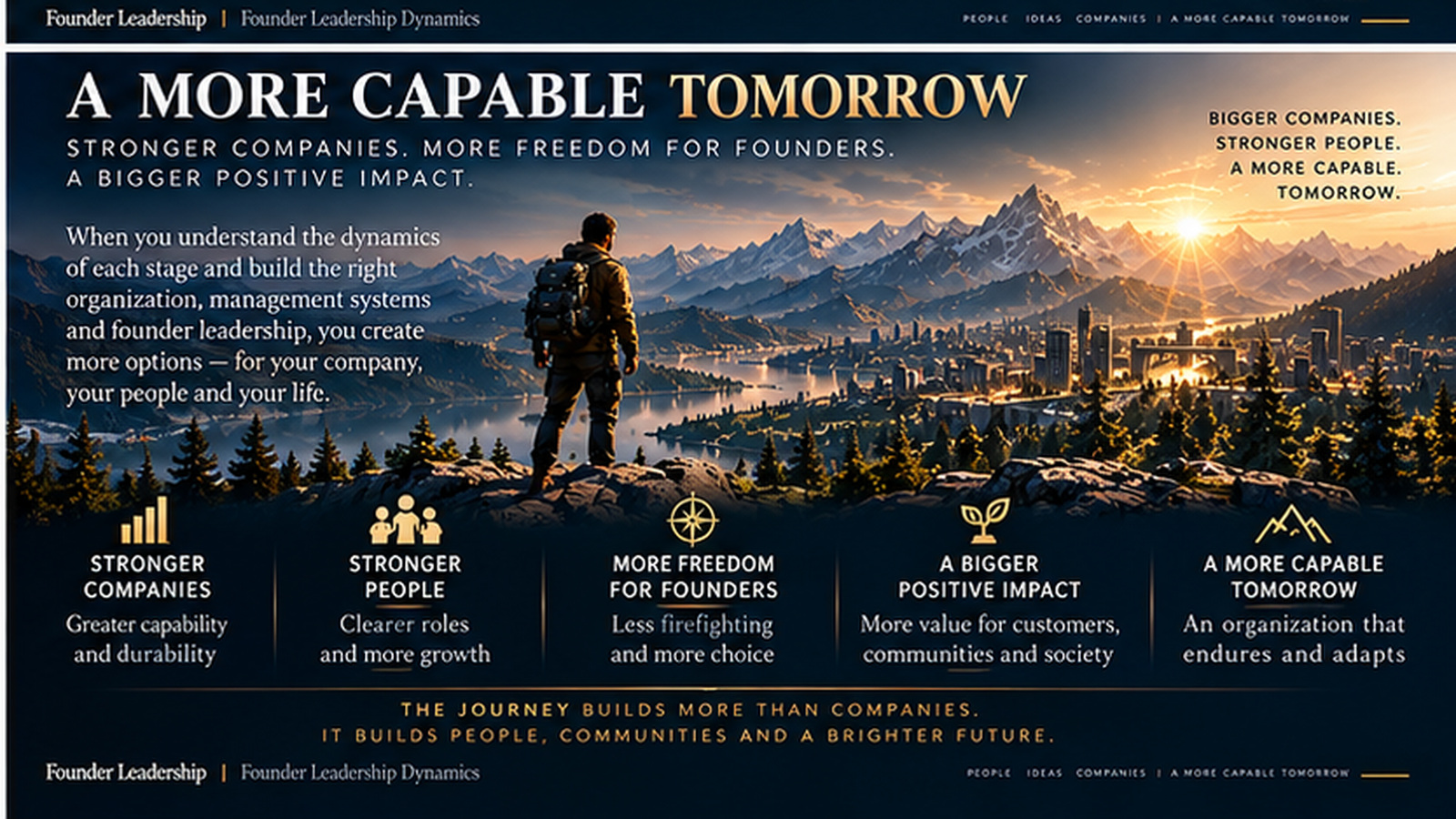
Viability precedes Repeatability. Repeatability creates the conditions for Organizational Capability. Organizational Capability makes Distributed Authority safer. Distributed Authority creates the foundation for Institutional Maturity.
Know the game. Master what this game requires. Then earn the right to play the next one.
Selected research references+
- Adizes, I. (1988). Corporate Lifecycles: How and Why Corporations Grow and Die and What to Do About It. Prentice Hall.
- Chandler, A. D. (1962). Strategy and Structure: Chapters in the History of the Industrial Enterprise. MIT Press.
- Churchill, N. C., & Lewis, V. L. (1983). The Five Stages of Small-Business Growth. Harvard Business Review, 61(3), 30–50.
- Flamholtz, E. G. (2002). Strategic Organizational Development, Growing Pains and Corporate Financial Performance: An Empirical Test. European Management Journal, 20(5), 527–536.
- Flamholtz, E. G., & Randle, Y. (2015/2016). Growing Pains: Building Sustainably Successful Organizations (5th ed.). Wiley.
- Galbraith, J. R. (1982). The Stages of Growth. Journal of Business Strategy, 3(1), 70–79.
- Greiner, L. E. (1972; updated 1998). Evolution and Revolution as Organizations Grow. Harvard Business Review.
- Hanks, S. H., Watson, C. J., Jansen, E., & Chandler, G. N. (1994). Tightening the Life-Cycle Construct. Entrepreneurship Theory and Practice, 18(2), 5–29.
- Kazanjian, R. K. (1988). Relation of Dominant Problems to Stages of Growth in Technology-Based New Ventures. Academy of Management Journal, 31(2), 257–279.
- Levie, J., & Lichtenstein, B. B. (2010). A Terminal Assessment of Stages Theory. Entrepreneurship Theory and Practice, 34(2), 317–350.
- Penrose, E. T. (1959). The Theory of the Growth of the Firm. Wiley.
- Phelps, R., Adams, R., & Bessant, J. (2007). Life Cycles of Growing Organizations. International Journal of Management Reviews, 9(1), 1–30.
- Scott, M., & Bruce, R. (1987). Five Stages of Growth in Small Business. Long Range Planning, 20(3), 45–52.
- Steinmetz, L. L. (1969). Critical Stages of Small Business Growth. Business Horizons, 12(1), 29–36.
What game is your company actually playing?
A Founder Leadership Conversation can help locate the current game, the capability it requires and the work that should come next.