
How to use the Founder's Map
The Founder's Map: User Guide
Updated 2026-10-22
Free version. Updated 2026-10-22.
This guide explains what the Founder's Map is, how to use it, how to read your result, and what to do next. Nothing here requires an account or a payment.
1. What the Map is

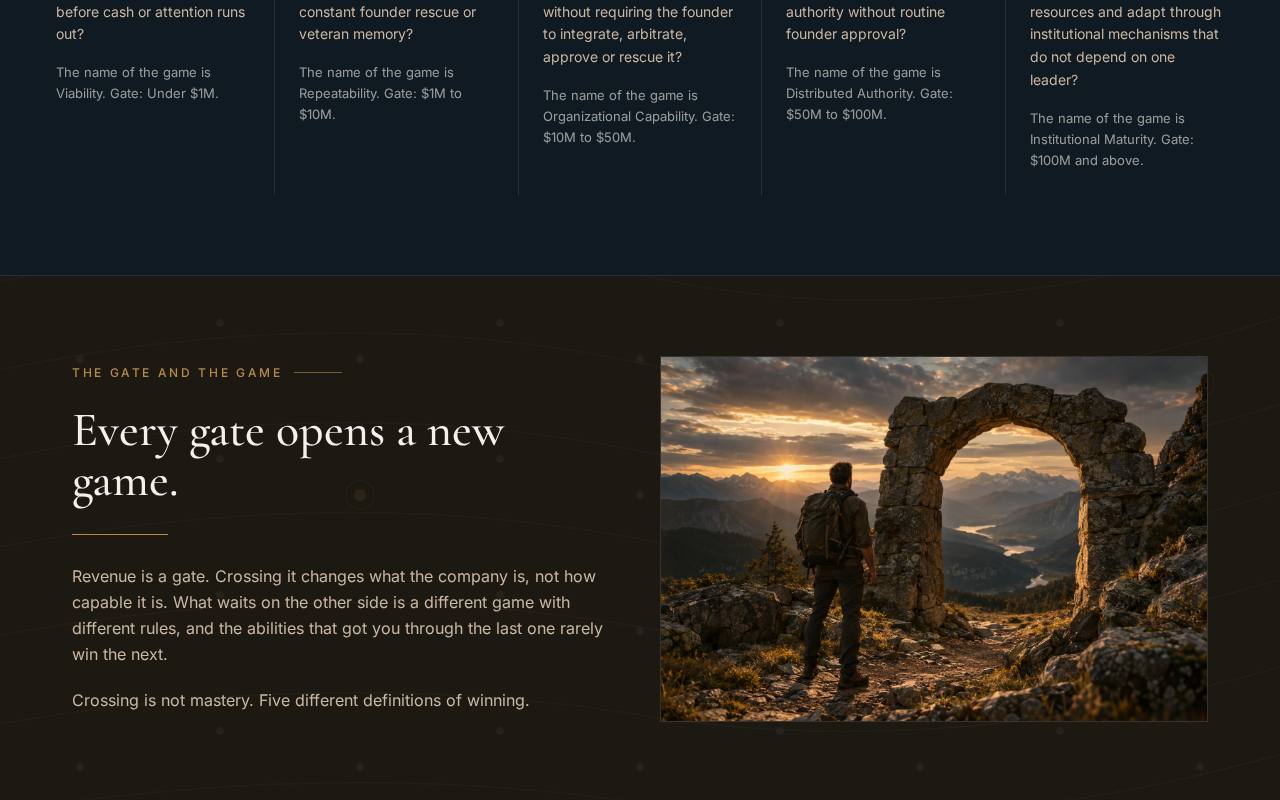
The Founder's Map is a free orientation tool. It asks ten behavioral questions about how your company operates day to day, then tells you which of the five games of scaling you are playing, where you sit inside that game, which challenge patterns are most likely active, and what capability the next gate will ask of you.
It is an orientation tool, not a diagnosis. It does not measure you as a person, it does not score your company's quality, and it does not treat a later stage as a prize. You have to know which game you are playing before you can determine how to win the game.
Three lines govern everything the Map says:
- Every gate opens a new game.
- Revenue marks the gate. Capability determines what comes next.
- Good advice can become bad advice in the wrong game.
2. The five games

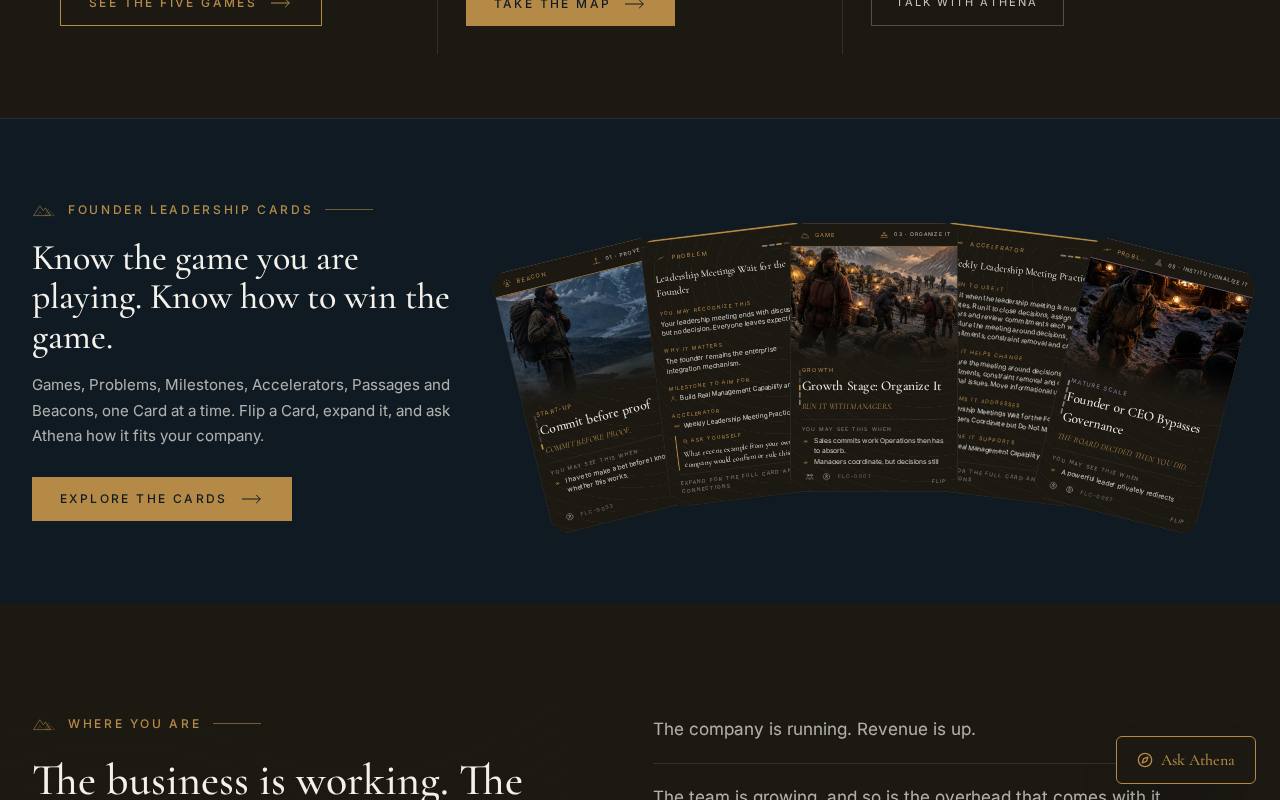
| Stage | Game | What it is really about |
|---|---|---|
| Start-Up | Prove It | Viability. Can this work at all? |
| Stable | Repeat It | Repeatability. Can it work without luck and heroics? |
| Growth | Organize It | Organizational capability. Can the organization handle what is coming? |
| Early Scale | Decentralize It | Distributed authority. Can decisions live where the information lives? |
| Mature Scale | Institutionalize It | Institutional maturity. Does the company outlast its founder? |
A gate is economic: a revenue threshold you cross. A game is behavioral: how the company runs day to day. Crossing a gate does not mean you have changed the game you are playing. That gap is the single most common source of the wrong advice being applied confidently.
3. How to use the Map

Start on the terrain
The cinematic terrain at the top of the page presents the five games as places. Hover or tap any marker to see a preview. Click or tap it to open the full stage: its gate, its central question, what the game rewards, the abilities it demands, the shifts it asks for, and the ways founders commonly get it wrong.
You can browse all five before answering anything. Many founders recognize themselves before they take the assessment.
Take the assessment
Choose Map My Stage. Ten questions, one at a time, about four to six minutes. No email, no account, no payment.
Answer for how things usually happen, not how you intend them to happen or how they went on your best week. The questions are behavioral on purpose: they ask what happens when a customer says yes, when a cross-functional issue lands, when a manager hits something the playbook does not cover, when a decision has lasting stakes, and what the company reverts to under pressure.
There are no right answers and no maturity labels on the options. Move through it quickly. First instinct is usually more accurate than a considered answer.
You can go back with Previous at any point before you finish.
Read your result
Your result appears immediately and in full. Nothing is withheld, emailed to you later, or reserved for a paid tier.
4. How to read your result

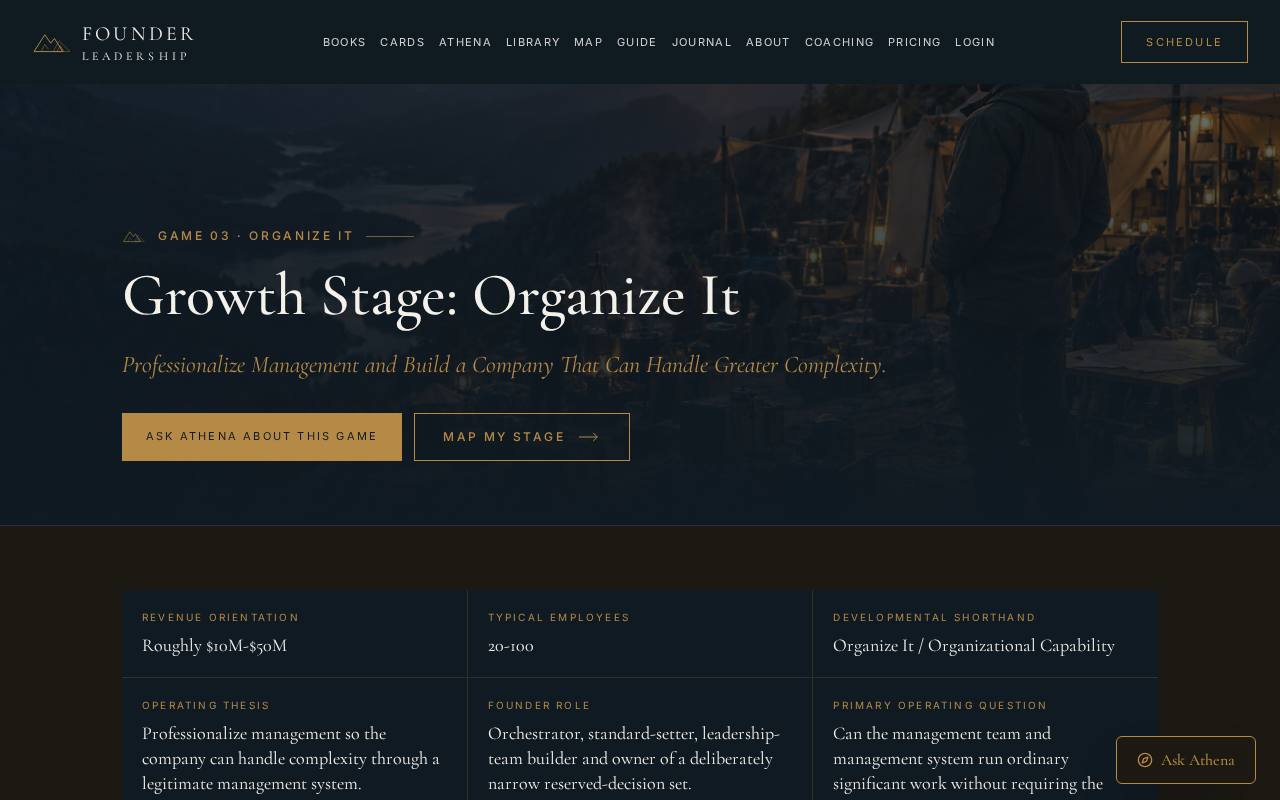
Your game. One of the five, with the attainment it is built around.
Your position. Entering, At Peak, or Exiting. Entering means the game is new and its demands are still unfamiliar. At Peak means you are operating inside its logic. Exiting means the next game's demands are already showing up.
Challenge patterns. Usually three, occasionally four. These are the frictions most likely active right now given how you answered. They are patterns, not verdicts. Read them as candidates to test against what you know about the last ninety days.
Revenue, Operations and Leadership. A directional read on which of the three is lagging the others. The Map only names a lagging dimension when the gap is clear. If they are close, it says so rather than manufacturing a weakness.
Capability, Authority and Identity. These appear only when the evidence is strong enough. Absence of a signal means the instrument did not see enough to say anything, not that the area is fine.
Next capability. The capability statement is followed by an interpretation of what your position and directional reading imply about where to begin.
The Playbook for This Stage. Every result includes a substantial field briefing before it warns you about the wrong moves. It explains the objective of the game, what winning looks like, where to focus, the capabilities the organization must develop, the shifts that move the company forward and the observable signs that the game is being won. The playbook is high-level guidance drawn from the Five Games framework, not a generic checklist or a substitute for understanding the specific company.
What the Map never shows you. There is no numeric score, no grade, and no ranking. A raw index exists internally to place you in a band, but showing it would invite founders to optimize the number instead of the work.
Guardrails, and why your result may be lower than you expected
The scoring keeps a result back when the supporting behavior is not there. If the company still depends on you personally for delivery or decisions, the Map will place you in the earlier game even when other answers point higher. Guardrails only ever lower a result. They never promote one.
If the result feels one game behind where you believe you are, that is usually the point of interest rather than an error. Take it to Athena and argue with it.
5. Gate versus Game

After your result, you can optionally enter your revenue band. The Map then compares the gate you have crossed economically against the game you are playing behaviorally.
This is optional, it comes after the result, and it never changes the result. It exists to make one distinction concrete: revenue tells you which gate you crossed. It tells you nothing about whether the company can operate at that level.
6. Talking it through with Athena


Athena is the conversational agent across this site. From the Map she arrives with your result already loaded: your game, your position, your challenge patterns, and your directional signals.
- On desktop she opens in a dock beside the terrain.
- On phones she opens in a bottom sheet.
- Voice is available. The microphone loads context and arms voice; it never records or speaks on its own. Press it once to arm, again to start listening.
- You can type instead at any time.
Useful openings:
- "Why did I land in this game and not the next one?"
- "Which of these challenge patterns should I work on first?"
- "Here is what happened last quarter. Does the result still apply?"
- "What would have to be true for me to be Exiting this game?"
Athena is instructed to interpret rather than defend the result, to pressure-test it against what you describe, and to say plainly when the evidence is thin.
7. On a phone

The Map works on a phone. The terrain becomes a static painting with a stage rail you can swipe, stage detail opens in a full-height sheet, the assessment shows one question per screen, and Athena opens in a bottom sheet. The full hover-driven terrain interaction is designed for a larger screen, and the page offers to email you a link so you can return to it on a desktop.
8. Your result is stored on your device
The Map saves your most recent result in your browser's local storage so it is still there when you come back. It is not attached to an account, and it is not sent anywhere unless you choose to share it.
That means the result does not follow you to another device or survive clearing your browser data. Retake replaces the stored result.
9. Where to go next


- The Founder's Gauntlet is the book behind the Map. It covers the five games in full.
- The Journal is free. Keep a record of what the current game is asking of you and watch the pattern change as the company does.
- Founder's Map Pro is optional, one hundred and fifty dollars once, for founders who want to keep mapping over time: lifetime access to the personalized mapping software, a deeper written report, and a forty minute Zoom debrief. Your free result is complete without it.
10. Common questions
Do I need an account? No. The assessment and the full result are ungated.
Will you email me my result? Only if you ask for a link to be sent. Nothing is gated behind an email address.
How accurate is it? It is ten questions. It is accurate enough to locate the work and start an honest conversation, not accurate enough to be the last word. Treat it as a first read, then pressure-test it.
Can I retake it? Yes, as often as you like. Retaking after a genuine change in how the company operates is the intended use.
My co-founder got a different result. That is information. Two people running the same company answering differently usually means authority and decision rights are less settled than either assumed.